The Future of AI in Manufacturing
Executive summary
Manufacturing productivity has plateaued. Despite decades of rising investment in automation, robotics, and digital systems, the gains are struggling to materialise. The machinery is faster, but the knowledge needed to design, improve, and operate processes at scale remains locked in people's heads, scattered documents, and disconnected systems. Traditional automation optimises what is already well-understood, but it cannot unlock performance from a blurry and incomplete picture.
Large language models (LLMs) represent a step change. They can act as a universal interface to manufacturing knowledge and systems, enabling conversational, role-aligned "agents" that accelerate daily work. More importantly, they can capture and codify previously unavailable knowledge, tribal expertise, unmanaged documentation, and unnoticed patterns, and feed it back into the design and improvement of processes and tools. This is where the next wave of productivity growth will come from.
The limiting factors are not model capability so much as context quality and real-world signals. AI agents need two things to be useful on a factory floor: rich, structured metadata about the entities that matter, machines, products, operators, schedules, shift patterns, and direct physical measurement of what is actually happening in real time. Without both, agents are either guessing from incomplete context or reporting numbers that nobody trusts.
The fastest path to value is to treat manufacturing information as an asset, elevate it into governed knowledge, and use LLMs to capture and structure what is currently unmanaged, tribal, or unknown. The end state is what we describe as manufacturing-as-code: a complete, version-controlled semantic model of the operation that AI agents can reason over as a coherent whole.
The core proposal is that the winners will not be those who simply "deploy an agent", but those who build a defensible 'context layer' that connects governed systems, documents, and operational data to trusted workflows, with strong controls, measurable ROI, and clear adoption pathways.
AI agents for process and performance improvement
We are already at a point technologically where it is possible to have productive conversations with AI agents that can support the roles responsible for designing, improving, and managing manufacturing processes, process engineers, continuous improvement leads, quality managers, production planners, and the teams that drive operational performance.
This is not about replacing frontline operators. It is about giving the people who analyse, improve, and govern manufacturing operations a dramatically more capable set of tools.
In practical terms, an agent can:
- Answer process and performance questions with evidence and citations to site data and documents
- Prepare shift handovers, exception reports, and improvement summaries
- Draft work instructions, change requests, and standard operating procedures
- Investigate recurring quality or downtime issues and propose hypotheses
- Automate routine analysis and reporting across systems
The principal blockers are access to accurate context and trustworthy measurements. Context means structured, maintained metadata about the operational entities involved: which machine, which product, which operator, which schedule, which shift. Trustworthy measurements mean direct sensing of the physical world, not estimates derived from ERP transactions or manually entered logs, but real-time signals from the shop floor itself. When you blend these two layers, the agent can report on what actually happened, not what was supposed to happen.
Four knowledge types in manufacturing
All contextual information in a manufacturing organisation broadly falls into four types:
- Governed Knowledge: codified, owned, accurate
- Unmanaged Knowledge: documented, but not governed
- Tribal Knowledge: known by people, shared informally, undocumented
- Unknowns: unresolved issues and undiscovered patterns
The strategic goal is to elevate as much information as possible into governed knowledge so that AI agents can operate with reliable context.
But context alone is not enough. It must be grounded in physical reality. Direct measurement from sensors on the shop floor, capturing what is actually happening at the point of production, provides the ground truth that turns metadata into reliable, real-time performance metrics. The combination of rich entity context and direct measurement is what allows AI to report on actuals (real production output, true cycle times, genuine downtime causes) rather than relying on lagging, manually entered, or estimated data.
Crucially, this is not a "wait until we have perfect data" story. One of the biggest opportunities from LLMs is using them to structure and codify knowledge that would otherwise remain unavailable for decision making and process improvement.
The LLM opportunity: turning tacit knowledge into perfomance improvements
LLMs differ from prior AI waves because they can work with natural language and semi-structured information, and can be wrapped into agents that complete multi-step tasks across tools. Where traditional automation hits the productivity ceiling because it can only execute what has already been codified, LLM agents can codify what was previously out of reach, and then use that knowledge to design and build better processes and tools. Their highest leverage in manufacturing is to bridge the gap between people, documentation, and systems, turning the knowledge layer from a bottleneck into an ever growing asset.

1. Governed Knowledge
- The foundation is well-maintained metadata about core entities: machines (capabilities, maintenance history, configuration), products (specs, routing, quality parameters), operators (skills, certifications, shift assignments), production schedules, and shift patterns.
- When this metadata is combined with real-time sensor data from the shop floor, agents can query not just what was planned but what actually occurred, and reconcile the two automatically.
- Agents can assemble answers, highlight exceptions, and provide analysis in the language of the user's role, grounded in measured reality rather than system-of-record assumptions.
- They can standardise reporting and reduce "spreadsheet bureaucracy" by generating performance metrics directly from blended context and measurement.
2. Unmanaged Knowledge
Often this is spreadsheets, PDFs, presentations, emails, and shared drives. For many manufacturers, this is where the majority of their operational knowledge lives.
LLM Opportunity:
- With document conversion and indexing, LLMs can extract, normalise, and summarise useful information.
- This enables restructuring into governed knowledge, such as approved SOPs, parameter windows, and troubleshooting guides.
- An untold number of startups have died thinking they can get companies to ditch Excel. LLMs can can continually re-process documents at little cost. Therefore allowing unstructured documents to co-exist with governed knowledge. This can remove a massive barrier to deployment.
3. Tribal Knowledge
In Six Sigma terms, tribal knowledge is information that is known but not documented, and it is often highly valuable.
- LLMs can capture this through structured interviews, shift handover prompts, and guided “explain what you did and why” workflows.
- Agents can propose standard templates to turn tacit practices into draft procedures for review.
- Speech-to-text models combined with the 'back-and-forth', conversational nature of AI agents provides an ability to systematically extract tribal knowledge from staff.
This is arguably the most revolutionary area for LLMs to operate in. There has never been a technology so well suited to capturing tribal knowledge than LLMs have the potential to be.
4. Unknowns
These are recurring problems without root cause, out-of-the-blue failures, and patterns nobody has noticed. Discovering them requires continuous, direct measurement... you cannot find what you do not observe.
- IoT sensors deployed at the point of production capture the real-time signals (vibration, temperature, power, cycle events, environmental conditions) that make hidden patterns visible.
- Traditional AI methods such as anomaly detection, deep learning, and edge analytics can detect early signals and predict outcomes from this sensor data.
- LLM agents can then correlate sensor signals with entity metadata, which machine, which product, which operator, which shift, to translate raw anomalies into contextualised investigations, recommended tests, and structured root cause documentation.
- The result is new knowledge that can be codified back into governed form, enriching the metadata layer and improving future detection.
The combination of direct physical measurement and rich entity context turns "data" into actions and reduces time-to-learning. The feedback loop between measurement, context, and codified knowledge is where compounding value is created.
Manufacturing-as-Code: the target state
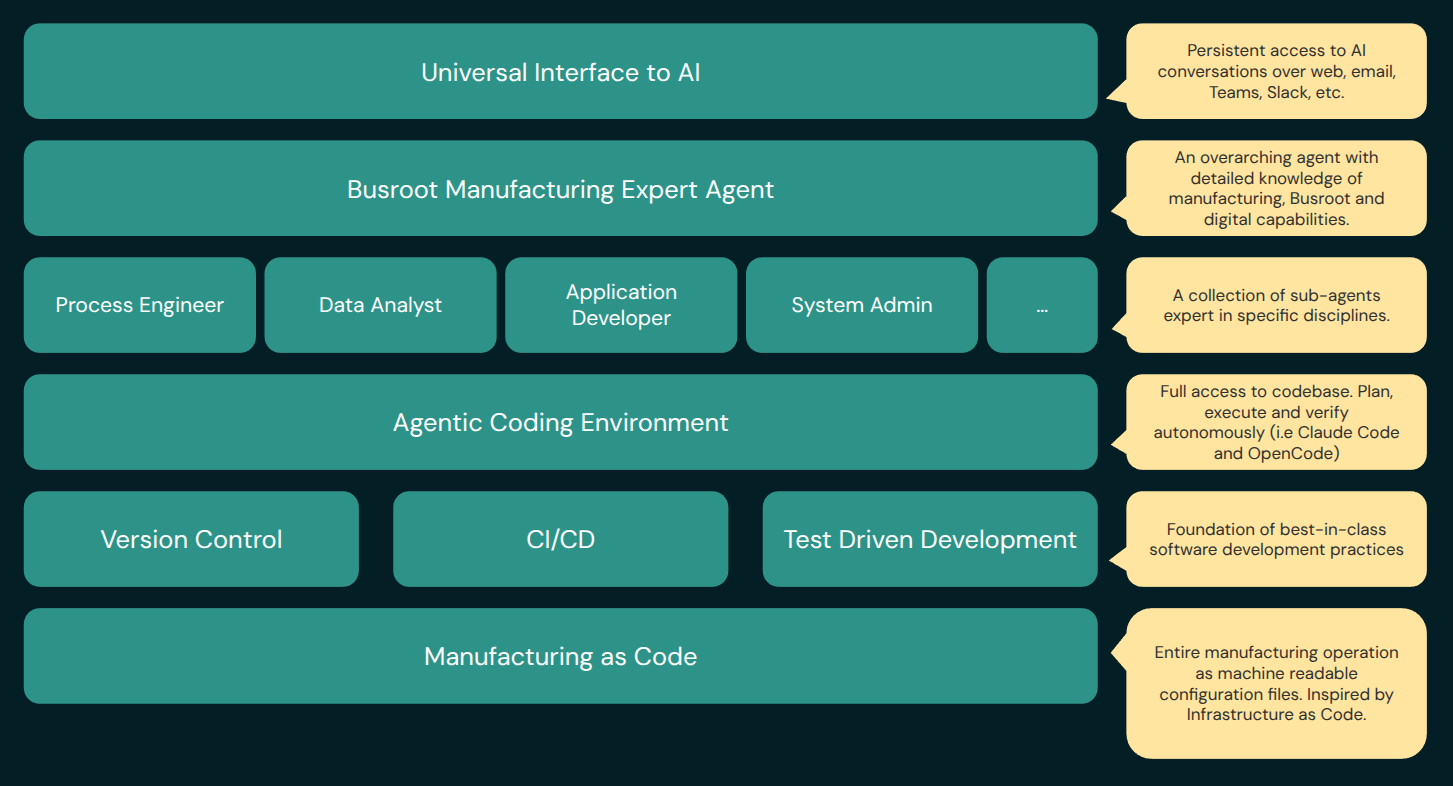
The concept of infrastructure-as-code transformed how software teams manage complexity. Instead of manually configuring servers, networks, and deployments, everything is defined in version-controlled, auditable, reviewable code. Changes are proposed, reviewed, tested, and deployed through CI/CD pipelines. The result: repeatability, traceability, and the ability to roll back when something goes wrong. This approach has become the industry standard because it works, and the same principles apply to manufacturing.
Manufacturing-as-Code is the practice of representing a manufacturing organisation's entire operational model, its machines, products, processes, operators, schedules, shift patterns, quality parameters, maintenance rules, and performance targets, as a structured, version-controlled, semantically rich model. This is the highest form of governed knowledge. It is the target state for everything extracted from unmanaged documents, tribal expertise, and newly discovered patterns.
When a process engineer's tribal knowledge about optimal machine settings is captured, it doesn't just get written into a document, it gets codified into the model, versioned, reviewed, and deployed. When a root cause investigation reveals a new failure mode, the finding is encoded as a rule or parameter in the model, not buried in an email thread. The model is the single source of truth for how the operation works.
The parallels to software engineering are deliberate and powerful:
The most significant benefit is what this means for AI agents. When the full semantic model of a manufacturing organisation is codified and available, an agent is no longer limited to answering questions from fragments of context. It has the complete operational picture at its fingertips: every machine and its configuration, every product and its routing, every operator and their certifications, every schedule and its constraints. The agent can reason across the full model, "if we move this product to that line, which operators are qualified, what does the maintenance window look like, and how does it affect the schedule?", because the relationships and rules are explicit, not implied.
There is a further advantage that is easy to underestimate: LLMs are natively good at reading and writing code. A Manufacturing-as-Code model is expressed in structured, human-readable definitions, and that is exactly the format LLMs handle best. An agent can read a machine definition, understand its relationships, propose a change, and write the updated configuration directly. Compare this to the alternatives: calling complex ERP APIs with rigid schemas and authentication layers, or trying to safely modify a relational database through SQL. Both are brittle, high-risk, and require specialist skills. Code-based models, by contrast, are the natural interface for LLMs, they can read them, reason about them, and edit them with the same fluency they bring to any programming language. A process engineer can describe a change in plain language, the agent can translate it into a model update, and the change flows through version control and review just like any other commit.
This is the difference between an AI that can answer narrow questions and one that can genuinely support operational decision-making. Manufacturing-as-Code turns the knowledge layer into something an agent can navigate, query, and reason over as a coherent whole.
Trust, safety, and adoption: addressing AI scepticism
Mistrust of AI will be a significant headwind. In industrial environments, “confidently incorrect” behaviour is unacceptable.
Any credible deployment requires mechanisms that:
- Make the agent show its sources and reasoning steps in a usable way
- Express confidence levels and uncertainty, and refuse to answer when evidence is insufficient
- Enforce permissions, change control, and segregation of duties
- Provide human approval gates for high-consequence actions
- Maintain audit trails for what was asked, what was answered, and what data was used
Adoption will be driven by reliability, explainability, and measurable outcomes, not novelty.
A pragmatic adoption path
A succinct, staged approach that aligns with how plants actually change:
-
Read-only copilots for governed and unmanaged knowledge
- Search, summarise, compare, report, explain
-
Knowledge capture workflows for tribal knowledge
- Structured interviews, handover automation, SOP drafting
-
Decision support with guardrails
- Recommendations with evidence, simulations, what-if analysis
-
Closed-loop automation in bounded domains
- Only where sensors, controls, and safety constraints are strong
Conclusion
AI in manufacturing is shifting from isolated optimisation to organisation-wide leverage. Traditional AI improves specific outcomes, while LLMs enable a new operating model where agents make knowledge accessible, capture expertise, and turn signals into action.
But none of this works without two foundational capabilities: a structured metadata layer that gives AI rich context about the entities that matter, machines, products, operators, schedules, shifts, and direct physical measurement from the shop floor that grounds everything in reality. When these two layers are blended in real time, the result is reliable, accurate performance metrics and the ability to report on what actually happened in production. That is the foundation on which AI agents can deliver genuine, measurable productivity gains.
The destination is Manufacturing-as-Code: a complete, version-controlled semantic model of the operation that agents can reason over as a whole, with the auditability, change control, and controlled rollout that manufacturing demands. The long-term winners will be those who build toward this model and the trust mechanisms that make agents reliable inside industrial workflows, and who can scale that value across sites.